

When customers select mesoporous carbon materials from Momentum Materials, one of the key questions is which carbon architecture best suits their catalysts in fuel cell stacks.
On datasheets, we provide many pore size options with varied surface areas, which can be overwhelming. This guide explains how to choose mesoporous carbon for catalysts in hydrogen fuel cells, using Momentum Materials’ NCP and MCP series as examples, and comparing them with Toyo Tanso’s CNovel™.
What is mesoporous carbon?
Mesoporous carbon is a carbon material with pore sizes in the 2–50 nm range. In hydrogen fuel cells, mesopores play a critical role because they prevent ionomer poisoning while enabling fast gas transport.
Unlike micropores (<2 nm), mesopores are large enough for catalyst deposition, improving catalyst dispersion while providing confinement that helps mitigate degradation.
Momentum Materials NCP vs MCP: differences and common ground
Momentum Materials offers two families of porous carbon used as fuel cell catalyst supports: NCP and MCP. They share important design principles, but differ in ways that matter for durability.
What they have in common
Both NCP and MCP are produced using a hard templating method (colloidal silica as the template), offering tunable pore sizes. Both can be high-temperature treated (HT) to increase graphitization, reduce surface hydrophilicity, and improve corrosion resistance. Both exhibit ordered pore structures, rather than random pore networks. This means performance differences are intentional design choices, not manufacturing noise.
Where they differ: precursor and purity
The key difference lies in the carbon precursor, which directly affects purity.
NCP Supports™ are made from synthetic mesophase pitch (naphthalene-derived), which has high purity and only trace silica residue from the template.
MCP series are produced from coal-tar or petroleum pitch and is battery-grade in purity, containing trace sulfur and magnetic impurities such as iron. These impurities are often acceptable in batteries, but are not welcome in hydrogen fuel cells.
How purity affects fuel cell performance and durability
Fuel cells are sensitive systems. Small impurities have outsized effects.
- Sulfur can poison platinum catalysts
- Iron accelerates membrane degradation
This means that two carbons with similar pore size or surface area can show very different decay rates over time due to impurities.
In durability-driven fuel cell designs, purity is not a “nice to have”; it directly affects catalyst lifetime and membrane stability.
How pore size affects performance (and surface area)
Pore size and surface area are linked. Smaller pores → higher surface area. Larger pores result in less surface area but better mass transport.
For fuel cells:
- Small mesopores (typically 4-10 nm) are ideal for hosting platinum-based catalysts and preventing ionomer poisoning
- Larger meso/macropores help reactant transport
- Micropores contribute little to fuel cell performance
In mesoporous NCP and MCP products, most of the surface area is accessible for catalyst dispersion, with only a small fraction of micropores.
Carbon wall thickness: the durability lever
Carbon wall thickness is a structural parameter that strongly correlates with carbon corrosion resistance. We quantify it by Lc(002) from XRD.
A tradeoff exists:
- Increasing surface area → thinner carbon walls
- Thinner walls → faster carbon corrosion
MCP-4-HT vs NCP-10-HT (practical example)
MCP-4-HT belongs to the MCP series. It features a small pore size of ~4 nm and a high surface area (>900 m2/g), with relatively thin carbon walls (Lc(002): 1-2 nm). MCP-4-HT has demonstrated strong initial performance but faster carbon corrosion under fuel cell operating conditions compared with NCP-10-HT.
NCP-10-HT belongs to the NCP Supports™, which has a pore size of ~10 nm and a moderately lower surface area (400 m2/g), but its thick carbon walls (~4–5 nm by Lc(002))offer significantly higher corrosion resistance and much lower performance decay rate (as shown in our NCP-10-HT case study).
For fuel cell engineers who care most about durability, this tradeoff matters more than peak power density.
Momentum Materials vs. Toyo Tanso
Toyo Tanso is a well-known supplier of mesoporous carbon. Its CNovel™ products feature tunable pore sizes with narrow distributions and are produced using a hard templating method with MgO as the template. At the same nominal pore size, CNovel™ exhibits higher surface area than Momentum Materials carbons.
| Product | Company | Pore size | BET surface area | Total pore volume | Micropore volume |
|---|---|---|---|---|---|
| MJ(4)010-00 * | Toyo Tanso | 10 nm | 1100 m²/g | 2.0 mL/g | 0.4 mL/g |
| NCP-10-HT | Momentum Materials | 10 nm | 400 m²/g | 1.4 mL/g | 0.03 mL/g** |
| MH-00 | Toyo Tanso | 5 nm | 1500 m²/g | 1.7 mL/g | 0.5 mL/g |
| MCP-4-HT | Momentum Materials | 4 nm | 1000 m²/g | 1.1 mL/g | 0.04 mL/g |
*Data from Toyo Tanso: https://www.toyotanso.com/Products/cnovel/data.html
**Momentum Materials’ micropore volume is calculated from T-plot.
At the same pore size, higher accessible surface area can benefit platinum dispersion and initial fuel cell efficiency, where CNovel™ shows an advantage. For example, platinum catalysts based on CNovel™ have reported ORR mass activities in the range of 399–731 A/gPt at 0.9 V (Hideo Daimon et al., 2025, J. Electrochem. Soc., 172, 034503), whereas NCP-10-HT exhibits an ORR mass activity of 182 A/gPt.
It should be noted that CNovel™ has a higher micropore fraction than Momentum Materials’ NCP and MCP, which partially contributes to its higher surface area.
Based on the trade-off between specific surface area and carbon wall thickness, Momentum Materials’ NCP and MCP are expected to have thicker carbon walls than CNovel™ at comparable pore sizes. Since no public Lc(002) data is available for CNovel™, this comparison is based on similar assumed carbon density rather than direct measurement.
You can see a hint of this difference in carbon durability testing. Under accelerated carbon corrosion testing between 1.0 V and 1.5 V at a ramp rate of 500 mV/s, CNovel™ shows a clear drop in performance at 0.5 A/cm² and 1.0 A/cm² after 1,000 cycles (Figure 1). By comparison, Momentum Materials’ NCP-10-HT maintained nearly the same performance at the same current densities even after 1000, 3000 and 5000 cycles (Figure 2). While the testing conditions are not identical, the takeaway is consistent: thicker carbon walls in mesoporous carbon structures are likely to play an important role in improving carbon durability.
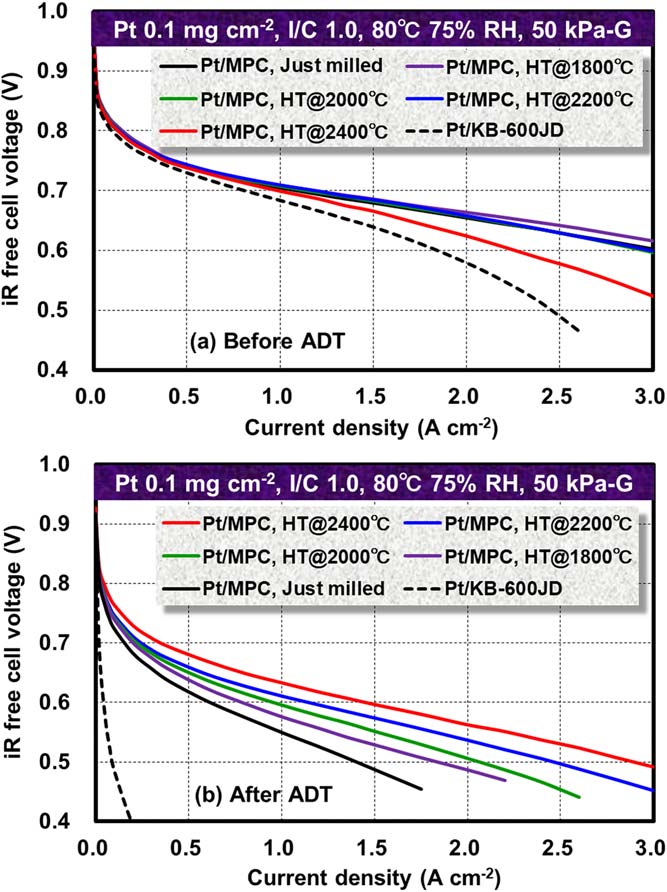
Figure 1. (a) Initial cell performance and (b) cell performance after accelerated carbon durability testing of CNovel™ (1000 cycles). Source: Hideo Daimon et al., 2025, J. Electrochem. Soc., 172, 034503.

Figure 2. Cell performance before and after accelerated durability testing of NCP-10-HT (5000 cycles). Source: Momentum Materials, NCP-10-HT case study.
What matters most for your catalyst or hydrogen fuel cell stack?
When selecting mesoporous carbon as a catalyst support for fuel cells, the decision usually comes down to a few practical tradeoffs:
- Are you optimizing for maximum initial performance, or for durability over thousands of operating hours?
- Is your system economics driven more by upfront stack cost (CAPEX), or by performance decay, replacement, and downtime (OPEX)?
Once these constraints are clear, it becomes much easier to select the mesoporous carbon architecture that fits your catalyst and stack design.
Practical selection guidance
| Priority | Recommended approach |
| Maximum initial performance | MCP-4-HT or CNovel™ |
| Long stack lifetime or reduced OPEX | NCP-10-HT |
| Cost-sensitive screening | MCP-4-HT |
Final takeaway
For hydrogen fuel cells, mesoporous carbon selection is about balancing purity, pore size and carbon wall thickness, as these factors are closely correlated with efficiency, durability, and cost.
MCP and NCP are both mesoporous carbons, but they are engineered for different priorities. If durability, decay rate, and system lifetime matter, carbon structure must be designed with intention. Momentum Materials team is dedicated to advanced porous carbon development and scale-up. Contact us today to learn more about our cutting-edge carbon materials and how they can benefit your industry.